
[AUDIO AND TEXT]
The world today is all jumbled up, as we all know. We strive to find a way to reconcile, internally or otherwise, the wars and injustices we see with the promise of peace that is offered by our various religious and philosophical traditions. But where does that reconciliation lie?
Here is St. Paul, in his letter to the Romans, chapter 8. I remember it as Romans 8:28 because it came to my attention on a particularly painful occasion in my life. Here’s what I remember (from the KJV): “All things work together for good, for them who love the Lord, for them who are called to His service.”
And here is the corresponding text from the New American Bible, which was given to me as the Catholic bible at the time of my baptism:
We know that God makes all things work together for the good of those who love God and are called according to his decree.” (Rom 8:28)
You can read the rest if you care to. This teaching goes on through Verse 34, but let’s not go there now.
For me, with our East-West perspective, I’d like to shorten that verse to read simply, “… all things work together for … good …”. No division into those who love God and are called and those who are not. That implies a duality that I’m reluctant, if not unwilling, to accept.
Now, here is the text of a Zen koan, Case 6 of the Hekinganroku, the Blue Cliff Record. I feel it as a kind of corollary to St. Paul’s utterance:
Unmon, giving instruction, said, “I don’t ask you about before the fifteenth day; bring me a phrase about after the fifteenth day.” Unmon himself answered in the monks’ stead, “Every day is a good day.”
Well, was Unmon just seeing the world through rose-colored glasses? And was St. Paul doing the same thing when he said, “All things work together for good?” How could that possibly be so, with all the pain and anguish and poverty and injustice that was working its way through the world, then and now? Are Paul and Unmon being idealistic or realized?
It’s probably difficult for us to see all things working together in any way these days, with all the discord that we are foisting upon each other around the world. How can we possibly assert that every day is a good day? It’s got to be a struggle for all of us to reconcile all this discord. But as we persevere in our meditation practice – and in our dedication to compassion and lovingkindness – we always return to the realization that we are in It. In fact, we are It. Whatever happens is It. And as Fr. Greg has always said, “We are whatever happens to be happening.” It.
Through practice, and in our daily living, we awaken, and we realize that everything is It. We accept What Is, as It. One single point, of No One Thing, which is at the same time, Everything.
Now, that doesn’t mean we are supposed to sit passively and allow everything to pass unnoticed and go unaddressed – all the bad, nor even all the good. No. We are called to behave and respond accordingly, while at the same time accepting all that is as It, the inescapable and yet sustaining It.
This is a hard teaching, to be sure. And however we respond to it is just that: our response to whatever is happening. That’s It. Just this. We do what we can to extend our base of compassion and lovingkindness and realization beyond our own skins into the flesh of the world. And in doing that, we are doing what we are. We are doing It. We may have little or nothing to say about the response we get, but we know we are doing us – we are doing It.
Just look at this piece of art, this masterpiece, which some of you may have seen in person.
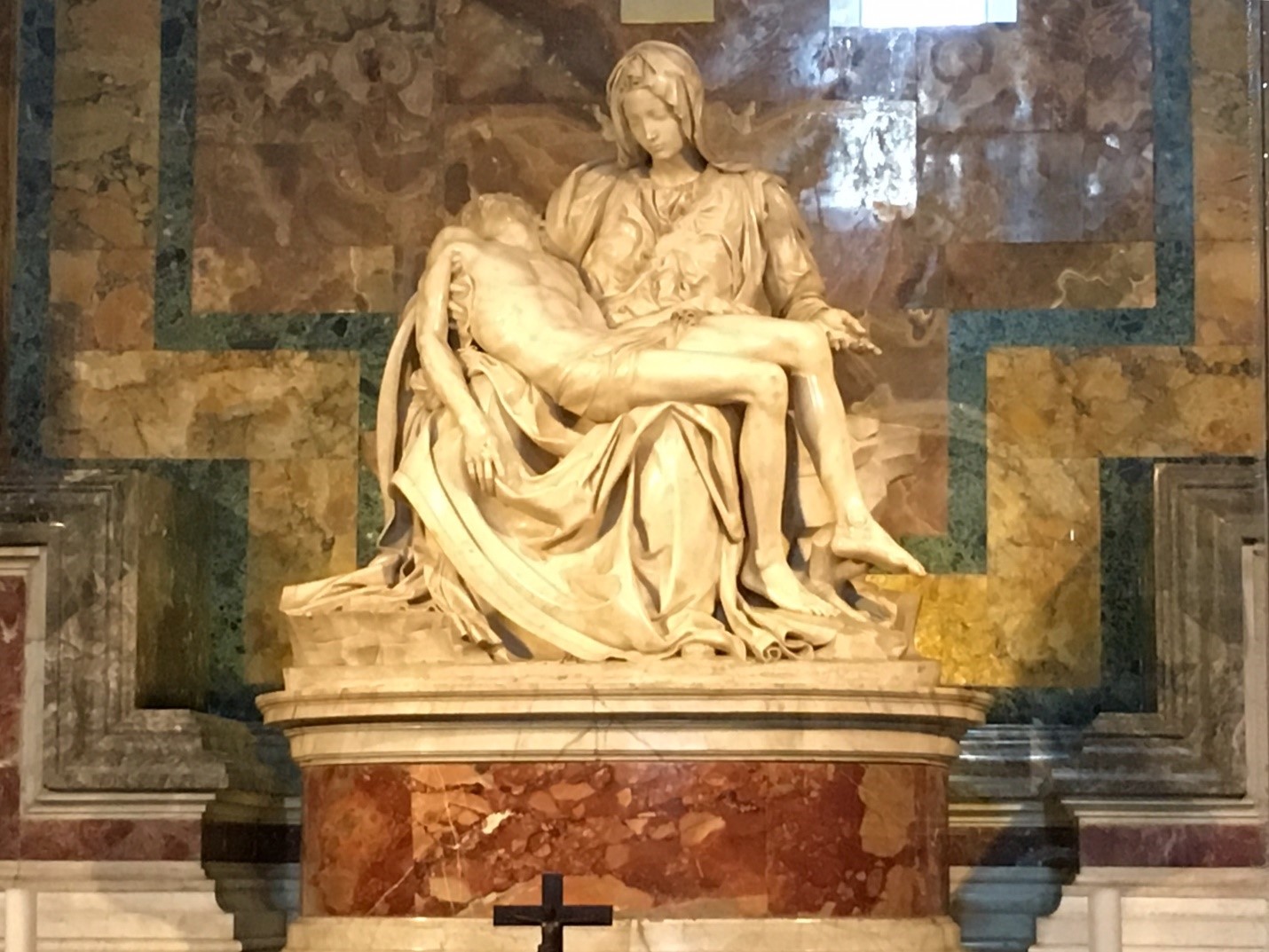
Here, the artist expresses his own Christian idiom. But what does that matter? If this isn’t a proof of one person doing It, I don’t know what is. It’s about looking into every scripture, every koan, to realize and experience what lies within.
Thank you.
 EMPTY CLOUD ZEN